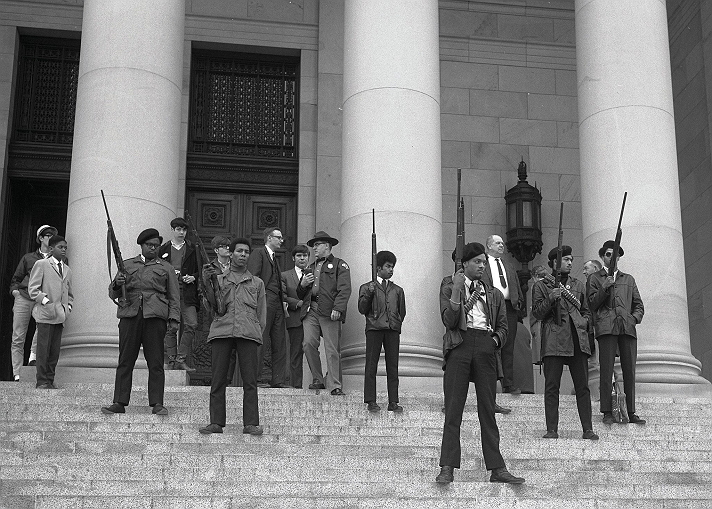



Black Panther Party demonstration at State Capitol, Sacramento, California, May 2nd, 1967 (Flickr)
The Urban Rebellions of the 1960s were assuredly a landmark in the complex history of the Black Liberation Movement. And although they have received significant chronicling, the next generation of scholars would do well to provide more analysis of how and why so many took to the streets—at times armed—just as it appeared that the hateful system of Jim Crow was seemingly in retreat.
Allow me to point you to my most recent book—Armed Struggle? Panthers and Communists; Black Nationalists & Liberals in Southern California through the Sixties and Seventies—in order to illuminate issues sketched below. As the title suggests, this work does not look at these diverse ideological forces in isolation from one another but, instead, limns their interactions. This approach allows for tracing the influences of one trend upon another.
Thus, although the historiographical consensus seems to be that—for example—the Panthers, which emerged from these rebellions were part of the “Black Power” trend, they are grouped in this regard alongside certain so-called “Cultural Nationalists” with whom they clashed sharply. Indeed, a number of Panthers were quite critical of the “Black Power” trend, which they associated with what they considered to be non-revolutionary Black Nationalism.
More than this, this approach elides the wider point that the Panthers—by their own admission—were deeply influenced by socialist and Marxist trends. Thus, Jonathan Jackson, the Pasadena teenager who led a shootout at a California courthouse, ostensibly to free his elder brother—the vaunted political prisoner, George Jackson—produced a high school newsletter, ‘Iskra’, homage to a Bolshevik publication of the same name. Leading Panthers were notorious for their study of now obscure Russian Marxists, e.g. Georgi Plekhanov, a name—I daresay—is wholly unrecognized by numerous students of this era. To be sure, the Panthers saw themselves as legatees of the heroic tradition of Malcolm X but—for whatever reason—the scholarly literature has tended to ignore or downplay the influence upon them of San Francisco born Communist William Patterson, who both influenced the legendary Paul Robeson and spearheaded the Scottsboro case of the 1930s, which set the stage for the agonizing retreat of Jim Crow. Perhaps this elision of ideological influences to the radical and socialist left was a capitulation to the resolution of the Cold War and the rise of the so-called “sole remaining superpower,” now in the process of being eclipsed by the rise of China?